







A sales strategy is a set of decisions about which customers you serve, what value you offer them, how you reach them and what results you aim to achieve. It gives your team a shared basis for deciding which opportunities to pursue and how to use its time and budget.
If those decisions stay in a slide deck, each rep fills in the gaps differently. One pursues every inquiry; another focuses on a narrow industry. This guide shows you how to write a strategy, turn it into daily work and check whether the choices behind it still make sense.
What is a sales strategy?
A sales strategy defines your target market, value proposition, routes to customers and commercial goals. It connects the customers you want with the resources and activities needed to win their business.
It should answer four questions:
- Who do we sell to, and who falls outside our target market?
- What problem do we solve, and why would those customers choose us?
- How will we reach them and support their buying decision?
- What result do we expect, by when and within what budget?
For example, an industrial maintenance supplier might focus on regional manufacturers that need rapid access to spare parts. That choice affects which partners it works with, what stock it holds and what its salespeople ask in the first conversation.
Your strategy sets the decisions. The way you sell puts them into practice through your offer, team, sales process and use of data.
How is a sales strategy different from a sales plan, process, methodology and tactics?
A strategy establishes commercial choices; the other elements organize their execution. Writing a call script or setting a quarterly quota leaves questions about your market and offer unanswered.
The time horizons below are examples. Choose a review cycle that fits your market.
| Element | Question it answers | Typical horizon | Owner | B2B example |
|---|---|---|---|---|
| Sales strategy | Who do we serve, why will they buy and how will we reach them? | One to three years, reviewed regularly | CEO and head of sales | Sell maintenance contracts to regional manufacturers through direct outreach and service partners |
| Sales plan | How much will we sell, by when and with which resources? | Year or quarter | Sales manager | Assign quarterly targets and budget for two reps |
| Sales process | What must happen as a deal moves toward a decision? | Used daily; revised when needed | Sales manager | Qualification, technical review, proposal, decision |
| Sales methodology | How do we understand needs and run conversations? | Used across relevant deals | Manager and team leads | Use SPIN questions to explore the impact of downtime |
| Sales tactics | What specific action will we take? | A conversation or campaign | Sales rep | Send a tailored follow-up after a technical meeting |
Your sales process should reflect your strategy. A methodology supports the conversations within that process; our guide explains how a methodology differs from a sales process. A go-to-market strategy has a wider scope, including product, pricing and marketing decisions.
Why does a company need a sales strategy?
A written strategy lets your team make consistent decisions and gives you a basis for reviewing results. Its practical value shows up when you have to choose where to spend limited time and money.
- Reps know which opportunities to prioritize. A prospect’s fit matters alongside the size of a possible contract.
- You can allocate resources deliberately. A segment requiring on-site technical visits needs a different budget from one buying through online consultations.
- You can compare results with your assumptions. If the target segment rarely buys, you have a specific choice to investigate.
- New hires can learn the reasoning behind the work. They see why the team qualifies certain needs or involves a technical specialist.
A weak quarter alone does not prove the strategy is wrong. Looking at segment fit, conversion and buying time helps you distinguish a change in the market from a problem in execution.
What should a sales strategy include?
A useful sales strategy covers customers, value, goals, channels, process, responsibilities and resources. Each decision should be specific enough to guide a real opportunity.
Who are your target customers?
Describe your ideal customer profile: the type of company most likely to benefit from your offer and buy profitably. Include industry, size, location, buying situation and relevant constraints.
For an IT services company, “businesses with computers” tells reps little. “Regional manufacturers with several sites and no internal infrastructure team” gives them a way to assess fit. Also record exclusions, such as locations you cannot service or projects below a viable contract value.
What value do you offer each segment?
Explain the customer’s problem, the outcome you help create and the evidence supporting that promise. Different buyers may value different outcomes from the same service.
A manufacturer might care about restoring production quickly. A professional services firm might care more about staff access and predictable support costs. Those differences should influence discovery questions and proposals.
What results do you want to achieve?
Specify a measurable result, a deadline and the resources available. Separate new business from renewals and expansion, since each depends on different opportunities.
Include commercial constraints. Revenue gained through heavy discounts may meet a volume target while missing your margin requirement.
Which channels and sales motions will you use?
Choose how each segment will find you and how your team will approach it. Assign a budget and an owner to each channel you plan to test.
A search inquiry, a distributor referral and a target account approached by a rep arrive with different knowledge and expectations. Your follow-up should reflect that.
What sales process will each segment follow?
Define the stages and evidence needed to move an opportunity forward. A repeat order may need only stock confirmation and approval. A first-time buyer of technical equipment may need a site survey, specification and procurement review.
Keep the process detailed enough to support the decision. A stage called “proposal sent” says less about progress than knowing whether the buyer has agreed on requirements and a decision date.
Who owns each part of the work?
State who handles prospecting, qualification, proposals, negotiation and customer development. In a small team, one person can own several roles.
Record handoffs and decision rights too: who accepts a qualified opportunity, who approves a discount and who takes over after the contract is signed.
Which tools, metrics and budget will you need?
List the data, systems, skills and time required to carry out the strategy. Budget for onboarding and ongoing administration alongside software and campaigns.
Choose a small set of metrics that test your assumptions. If your strategy depends on higher-value contracts in a new segment, track contract value and margin there rather than relying on total activity counts.
What are the main types of sales strategies?
Sales strategies differ along several dimensions: how you reach buyers, how you organize account coverage and how you help customers evaluate value. You can combine these choices.
| Dimension | Options | What the decision changes |
|---|---|---|
| Customer acquisition | Inbound or outbound | Whether customers initiate contact or your team approaches selected prospects |
| Account coverage | Broad segment coverage or account-based selling | Whether you spread effort across a market or coordinate work around selected accounts |
| Route to market | Direct or partner selling | Whether your team sells to the buyer or works through distributors, resellers or referral partners |
| Selling approach | Consultative or value-based selling | How you investigate needs and connect the offer to business outcomes |
Inbound suits situations where buyers research a recognizable problem and can find your content, events or recommendations. Outbound lets your team approach companies meeting specific criteria, such as manufacturers opening a new facility.
Account-based selling concentrates resources on selected companies and their buying groups. It can accompany outbound outreach, partner introductions and inbound content. Partner selling uses a partner’s access or expertise, with clear responsibilities for qualification, support and customer ownership.
Consultative and value-based approaches shape the conversations across those channels. They are another dimension of the strategy, rather than a separate acquisition channel. Likewise, B2B and B2C describe who buys; they provide context for the strategy.
Sales methodologies such as SPIN, MEDDIC or Challenger help teams structure conversations and assess opportunities. BANT is a qualification framework. None of them replaces decisions about your market, offer or budget.
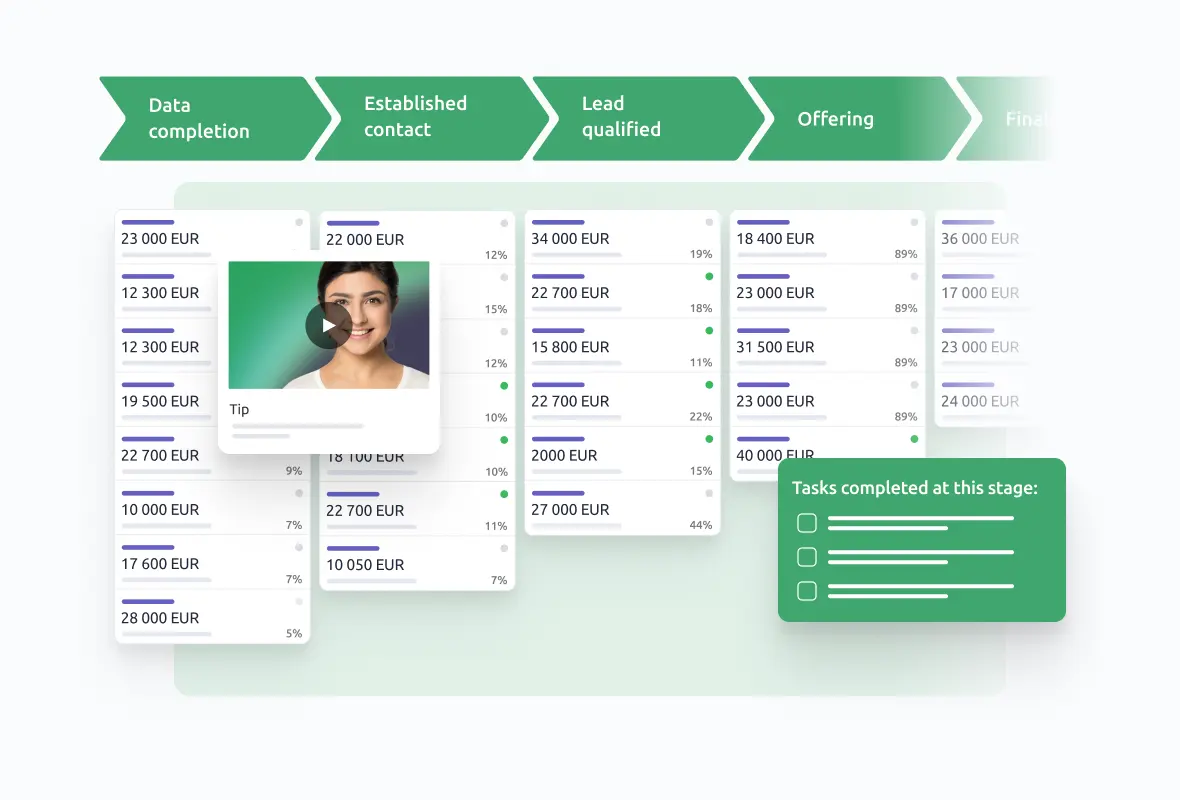
An example of turning a chosen sales approach into stages and tasks in Livespace.
How do you create a sales strategy in 7 steps?
Start with evidence from your current customers, choose where to focus and translate those choices into targets and responsibilities. Finish by scheduling the review that will test your assumptions.
1. Review where you are
Look at the last year’s won and lost opportunities by customer segment, source, contract value and buying time. Include existing customers and deals that ended without a decision.
Ask where you win profitably and where your team spends time without making progress. If the records are incomplete, audit your current sales process and agree on the minimum data to capture before drawing firm conclusions.
2. Choose your segments and ideal customer profile
Select the groups where customer need, your capabilities and the economics fit. Validate them through conversations with customers as well as CRM records.
Write down the signals a rep can observe. “Values quality” is hard to qualify; a requirement for a documented service response time is much clearer.
3. Define your value proposition for each segment
Connect a specific problem to an outcome you can support with evidence. Explain what the customer needs to contribute for that outcome to be achievable.
Check your proposition with customers. The reason your team believes it wins may differ from the reason buyers actually chose it.
4. Work back from your target to the pipeline you need
Use your average won contract value and win rate to estimate the number of qualified opportunities required. Keep the definition of a qualified opportunity consistent with the data used in the calculation.
For example, with an illustrative annual new-business target of $500,000, an average won contract of $25,000 and a 25% win rate:
- $500,000 ÷ $25,000 = 20 wins;
- 20 ÷ 0.25 = 80 qualified opportunities;
- 80 ÷ 4 = 20 opportunities per quarter, if demand is evenly distributed.
Account for seasonality, buying time and delivery capacity. Opportunities created late in the year may not close within the target period.
For context, the 2024 Livespace B2B Sales Benchmarks Report reported a 44% win rate and 41 days to win across more than 1,200 SME customers, using data from early 2022 through Q3 2024. Those historical averages provide context; use your own comparable segment data for planning.
5. Pick channels for each segment
Decide which channels you can staff and fund. For every test, record the target segment, offer, expected cost, qualification criteria and review date.
Compare channels using qualified opportunities and eventual business outcomes. A low inquiry cost can still produce expensive customers if few inquiries fit your offer.
6. Turn the choices into a process for each buying situation
Translate qualification criteria, proposal requirements and approvals into stages and steps. Use separate processes when buying situations differ enough to require them; every segment does not automatically need its own pipeline.
For example, a distributor’s repeat orders and a new direct customer’s first purchase may follow different paths. A small team can still manage both when responsibilities and required actions are clear.
7. Decide who reviews the strategy and when
Name an owner and put reviews in the calendar. One possible rhythm is a monthly pipeline review and a quarterly strategy review, with an earlier discussion after a material market change.
At each review, record the assumption being tested, the evidence, the decision and its owner. Change a channel or qualification rule deliberately, so you can assess its effect later.
How do you know if your sales strategy is working?
Compare results with the assumptions behind your target segments, value proposition and channels. Review trends within comparable groups; a company-wide average can hide a segment that is struggling.
| Metric | What it helps you investigate |
|---|---|
| Win rate | Whether qualified opportunities in the chosen segment become customers |
| Average contract value and margin | Whether the business you win supports the economics of the strategy |
| Sales cycle | Whether the buying time fits your targets and available capacity |
| Conversion between stages | Where opportunities stop moving toward a decision |
| Customer acquisition cost | Whether a channel’s full costs are justified by the customers it brings |
| Retention and repeat purchases | Whether customers continue to find value after the first sale |
Read more about sales metrics worth tracking before defining your reporting rules. A drop in conversion is a reason to investigate conversations and records; it does not identify the cause on its own.
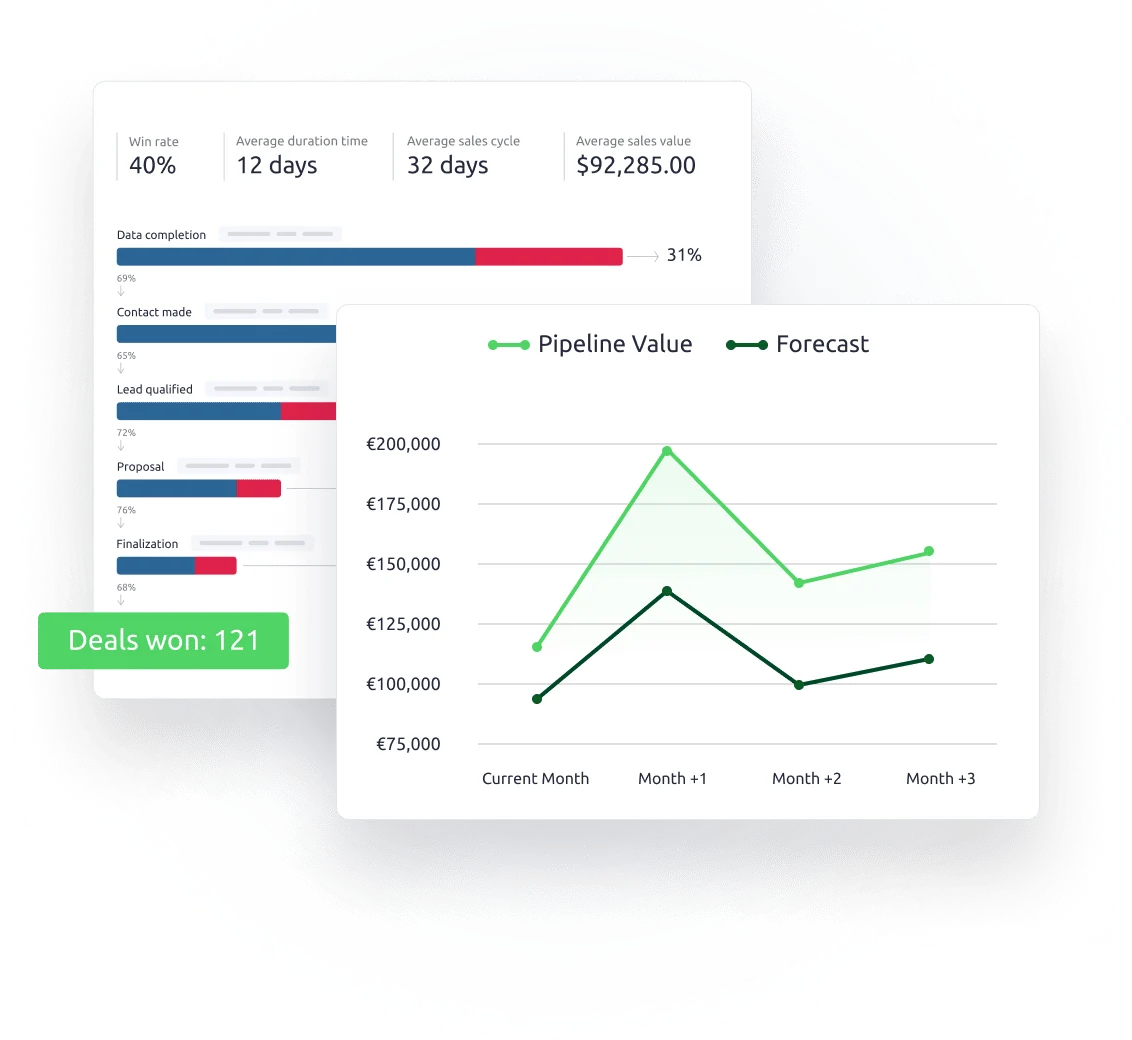
Illustrative report data. Review conversion and buying time alongside your revenue target.
How does a CRM help you put a sales strategy into practice?
A CRM gives the team a shared place to apply qualification rules, record next steps and review outcomes. Understanding what a CRM does helps you decide which information should be recorded there.
In Livespace, you can configure sales processes with your own stages, tasks and checklists. A technical assessment required by your strategy can become a step in the relevant process. Reports then show conversion between stages, helping you investigate where opportunities stall.
This depends on the team recording opportunities and updating them consistently. Someone must also review the data and make decisions. The system can show how your choices perform; choosing the customers and offer remains your responsibility.
Why do sales strategies fail in practice?
Strategies often become difficult to execute when responsibilities, time or working rules do not match the plan. Check these points before adding another campaign:
- No named owner. Assign someone to review evidence and coordinate changes.
- The target market is too broad. Give reps usable inclusion and exclusion criteria.
- The process does not reflect the offer. Make required discovery, validation and approvals visible in daily work.
- The workload exceeds capacity. Allow time for qualification, preparation and follow-up.
- Discount decisions are unclear. Set approval rules and track the effect on margin.
- No review takes place. Put a recurring decision meeting in the calendar.
Capacity deserves particular attention. Reps lose a large share of their week to admin, internal meetings and data entry. Check your own team’s workload before assuming that headcount translates directly into selling time.
Sales strategy example: a small US B2B services company
Consider a fictional managed IT services company in Ohio with four salespeople. The figures and decisions below illustrate a strategy; they are not a customer case study.
| Element | Decision |
|---|---|
| Target customers | Manufacturers in Ohio and neighboring states with 50–250 employees and limited internal IT support |
| Value proposition | Documented support response times and maintenance scheduled around production |
| Annual target | $500,000 in new contracted business, using one consistent contract-value measure |
| Average won contract | $25,000, giving a target of 20 wins |
| Planning win rate | An illustrative 25%, requiring 80 qualified opportunities |
| Channels | Direct outreach to selected accounts, complemented by referrals from equipment-service partners |
| Process | Qualification, technical assessment, proposal review, decision |
| Responsibilities | Reps qualify; a technical lead validates scope; the sales manager approves exceptions |
| Review | Monthly pipeline review and quarterly review of segment, channel and margin performance |
The strategy gives the team a reason for each step. A technical assessment belongs in the process because the offer depends on understanding the customer’s production environment. The manager can review whether that assessment helps produce viable proposals and profitable contracts.
Frequently asked questions
What is a sales strategy in simple terms?
A sales strategy states who you want to sell to, why they would buy from you, how you will reach them and what results you expect. It guides decisions about customers, people and spending.
What are the four main types of sales strategies?
One useful way to group acquisition and market coverage is inbound, outbound, account-based selling and partner selling. They overlap: account-based selling can use outbound outreach and partner introductions. There is no universal list of four mutually exclusive types.
What is the difference between a sales strategy and a sales plan?
A strategy defines choices about customers, value and routes to market. A sales plan assigns targets, resources and deadlines to carry out those choices over a period.
What is the difference between a sales strategy and a sales process?
A strategy explains the commercial choices behind your sales activity. A process defines the stages and actions an opportunity goes through. Its requirements should reflect the customers and offer you chose.
What should a sales strategy include?
Include target customers, value proposition, goals, channels, sales processes, team responsibilities, tools, budget and review rules. Record exclusions and constraints so reps can make consistent decisions.
Who is responsible for the sales strategy?
The CEO or owner and head of sales usually share responsibility for the main commercial choices. Name one person to maintain the strategy and organize reviews, with input from marketing, finance and delivery.
How often should you review your sales strategy?
Choose a rhythm that fits your sales cycle and market. A quarterly strategy review supported by monthly pipeline checks is one option. Review sooner when a significant change affects demand, pricing or delivery.
Is there a sales strategy template?
Use the example table above as a starting structure. Replace each row with your own evidence, decisions and owner, then add a review date. The first version can fit on one page if the decisions are specific.
Your next step
Write down your target customers, offer, channels, goals and responsibilities. Check whether your current sales processes reflect those decisions and whether your data lets you review them. Assign an owner and schedule the first review.
To see how stages and tasks could reflect your team’s strategy, explore the CRM during a free trial.

Turn this into results
See Livespace on your own data, or try it yourself — no card, no commitment.